How to Know If Your Puppy Has Parvo
A puppy who was bouncing around yesterday and now won’t touch breakfast is worrying enough. Add vomiting or runny, smelly diarrhea and most owners’ minds go straight to parvo.
You can’t diagnose parvo at home. Only a vet test can confirm it. What you can do is recognize the warning signs early, keep your puppy away from other dogs, and get to a clinic fast, because early treatment makes a big difference to survival.
What parvo is and which puppies get it
Canine parvovirus is a highly contagious virus that attacks the lining of the gut and the bone marrow. It spreads through infected feces, and a puppy can pick it up from the ground, from shoes, bowls, hands or another dog’s coat.
The puppies most at risk are those between 6 weeks and 6 months old who haven’t finished their vaccinations. The Merck Veterinary Manual also lists Rottweilers, Dobermans, English Springer Spaniels, German Shepherds and pit bull-type dogs as breeds at higher risk.
Very young puppies usually have some protection from their mother’s antibodies if she was vaccinated. That protection fades, and it fades at different times in different puppies. That’s why vets give a series of jabs rather than one.
Early signs of parvo in a puppy
Parvo rarely starts with the dramatic bloody diarrhea people picture. According to Merck, the first signs are usually loss of appetite, lethargy, fever and vomiting. Diarrhea tends to follow within 24 to 48 hours, and it’s often bloody.
Look out for these changes:
- Your puppy is unusually quiet, sleepy or doesn’t want to play
- They refuse food, even favorite treats
- Vomiting, sometimes repeatedly
- Diarrhea that may be watery, very smelly, or contain blood
- A hunched posture or signs of a sore tummy
- Gums that look pale or feel tacky and dry
- Skin that’s slow to settle back when you gently lift it at the scruff, a sign of dehydration
Not every case looks the same. Merck notes that around a quarter of dogs with parvo have diarrhea without blood in it, so clear diarrhea doesn’t rule it out.
Parvo signs compared with milder tummy upsets
Lots of things upset a puppy’s stomach, from a diet change to eating something from the garden. This table shows how parvo usually differs. It’s a guide for deciding how fast to act, not a way to diagnose.
| Sign | More typical of parvo | More typical of a mild upset | How urgent |
|---|---|---|---|
| Energy | Very flat, weak, sleeping a lot | Still fairly playful | Lethargy plus vomiting means same-day vet |
| Appetite | Refuses food completely | Eats, maybe a little less | Refusing food for a day in a young puppy needs a call |
| Vomiting | Repeated, can’t keep water down | Once or twice, then settles | Repeated vomiting is urgent |
| Diarrhea | Often bloody, foul-smelling, frequent | Soft or loose, improves within a day | Blood in a puppy’s stool is urgent |
| Vaccination status | Unvaccinated or part-way through the course | Fully vaccinated | Any doubt about vaccines raises the urgency |
| Recent exposure | New puppy, rescue, park, sick dog contact | Diet change, scavenging | Tell the clinic about exposure when you phone |
If your puppy’s stool is loose but they’re bright and eating, our guide to soft dog poop covers the more everyday causes. Stool that looks slimy or coated may point elsewhere, and jelly-like poop explains what mucus usually means.
How long after exposure do signs appear?
Merck puts the usual incubation at 5 to 7 days, with a possible range of 2 to 14 days. The AKC gives a similar window of 3 to 7 days.
This matters if you’ve just brought a puppy home. Puppies can start shedding the virus in their feces 4 to 5 days after exposure, often before they look ill. A puppy who seems healthy on collection day can still be incubating it.
How vets confirm parvo
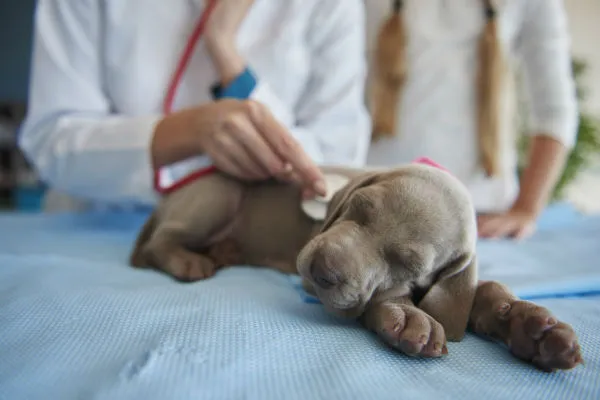
Most clinics use a rapid fecal antigen test, often called a snap test or ELISA. The AKC says results are usually ready in under 15 minutes. Vets often pair it with blood work, because a low white blood cell count is a hallmark of the disease.
The test isn’t perfect. Merck explains that false negatives can happen very early on, before the virus peaks, and later in the illness when shedding has dropped. If the test is negative but your puppy fits the picture, your vet may repeat it or send a PCR test to a lab.
Recent vaccination can occasionally affect results too, so tell the vet when your puppy last had a jab.
What to do right now if you suspect parvo
Speed matters more than anything else here. These steps help your puppy and protect other dogs.
- Phone your vet before you go in. Most clinics will ask you to wait in the car or use a side entrance so the virus doesn’t spread through the waiting room.
- Tell them your puppy’s age, vaccination dates, symptoms and any recent contact with other dogs or public places.
- Keep your puppy away from all other dogs, including your own. Don’t walk them anywhere.
- Take a fresh stool sample if you can do it safely, in a sealed bag.
- Don’t give human medicines or anti-diarrhea products. Merck notes antidiarrheal drugs aren’t recommended for parvo.
- If it’s out of hours, go to an emergency clinic rather than waiting for the morning.
Treatment and survival
There’s no drug that kills the parvovirus itself. Treatment is supportive. That means fluids to correct dehydration, medicine to stop vomiting, nutrition, and often antibiotics to deal with bacteria leaking from the damaged gut. Merck also mentions a conditionally approved monoclonal antibody that some clinics now use.
The outlook with care is good. The AKC quotes a survival rate of 68 to 90 percent with treatment, and Merck says more than 90 percent of dogs treated aggressively in hospital survive. Without treatment, the AKC says around 90 percent of puppies die.
Hospital care is expensive, so some vets offer an outpatient plan for owners who can’t afford a full stay. Merck reports around 80 percent survival with outpatient protocols. Ask your vet what’s possible rather than assuming it’s hospital or nothing.
Caring for your puppy at home afterwards
Recovered puppies are tired and their gut needs time. Your vet will guide the diet, usually something bland and easy to digest in small, frequent meals. Keep fresh water within reach, and if your puppy is reluctant to drink, our tips on getting a puppy to drink water can help. Only give an electrolyte drink if your vet agrees.
Your puppy can keep shedding the virus for a while after recovery. Ask your vet how long to keep them apart from unvaccinated dogs.
Cleaning your home after parvo
Parvo is a tough virus. Merck says it can stay infectious indoors for at least two months and outdoors for many months, possibly years, when it’s shaded and damp.
Ordinary household cleaners won’t do. Clean away all feces and dirt first, then disinfect hard surfaces with diluted bleach. Merck gives a 1:30 dilution of household bleach. Potassium peroxymonosulfate and accelerated hydrogen peroxide products also work. Merck warns that quaternary ammonium disinfectants, common in many pet-safe sprays, aren’t reliable against parvo.
Wash bedding and soft toys on a hot cycle or throw them away. Bowls can be soaked in the bleach solution and rinsed well. Grass and soil can’t be disinfected properly, so ask your vet how long to wait before a new puppy uses that garden. For tips on dealing with any vomit, see how to clean up dog sick.
Preventing parvo
Vaccination is the most effective protection. Merck describes a course of modified live vaccine at roughly 6 to 8 weeks, 10 to 12 weeks and 14 to 16 weeks, a booster a year later, then every three years. The AKC notes some puppies in high-risk places like shelters may need an extra dose at 18 to 20 weeks. Our guide to puppy vaccination timing goes into more detail.
Until the course is finished, carry your puppy in public places rather than letting them walk where unknown dogs go. Puppy classes that require proof of vaccination are usually a reasonable risk, and socialization still matters. Our article on how far to walk a puppy covers when proper walks can start.
When buying, ask the breeder or rescue for vaccine records. Our lists of questions to ask when buying a puppy and red flags when picking out a puppy are worth reading before you collect.
Common mistakes owners make
- Waiting to see if it passes. A day can make a real difference with parvo.
- Assuming a partly vaccinated puppy is protected. Protection isn’t reliable until the full course is done.
- Walking into the clinic without phoning first and spreading the virus to other patients.
- Using a standard pet-safe disinfectant that doesn’t kill parvo.
- Trying home “parvo cures” sold online instead of getting veterinary treatment.
- Bringing a new puppy into a home that had parvo without checking with the vet first.
When to call the vet
Call your vet straight away, or an emergency clinic out of hours, if a young or not fully vaccinated puppy has any of these:
- Vomiting more than once, or can’t keep water down
- Diarrhea with blood in it
- Refusing food along with lethargy
- Pale gums, cold paws, collapse or weakness
- Signs of a painful belly
Even if your puppy is vaccinated, these signs need a vet. Plenty of other serious illnesses look similar, and some, like a swallowed object or worms, also need quick treatment. Our guide to how often to worm your dog is a good place to check you’re up to date.
FAQ
Can a vaccinated puppy still get parvo?
Yes, it’s possible, especially if the course isn’t finished or maternal antibodies blocked an early jab. Fully vaccinated adult dogs are rarely affected.
Can I test my puppy for parvo at home?
Home test kits exist, but a vet should still examine your puppy. Merck explains that early and late tests can give false negatives, and a sick puppy needs treatment either way.
How long does parvo last?
Most puppies are seriously ill for several days to around a week, and recovery takes longer. The worst period is usually the first few days of symptoms.
Does parvo smell?
Many owners describe parvo diarrhea as having a strong, unusually foul smell. Smell alone isn’t a reliable sign, though. If you’ve noticed puppy stool smells worse than usual, see why puppy poop smells so bad.
Can people catch parvo from dogs?
No. Canine parvovirus doesn’t infect people. You can carry it on shoes and clothes to other dogs, though, so wash up and change after handling a sick puppy.
Can older dogs get parvo?
They can, but it’s much less common. Merck notes that among dogs older than 6 months, unvaccinated intact males are at higher risk.
This article is for general information and isn’t a substitute for advice from your vet. Last reviewed November 2026.